


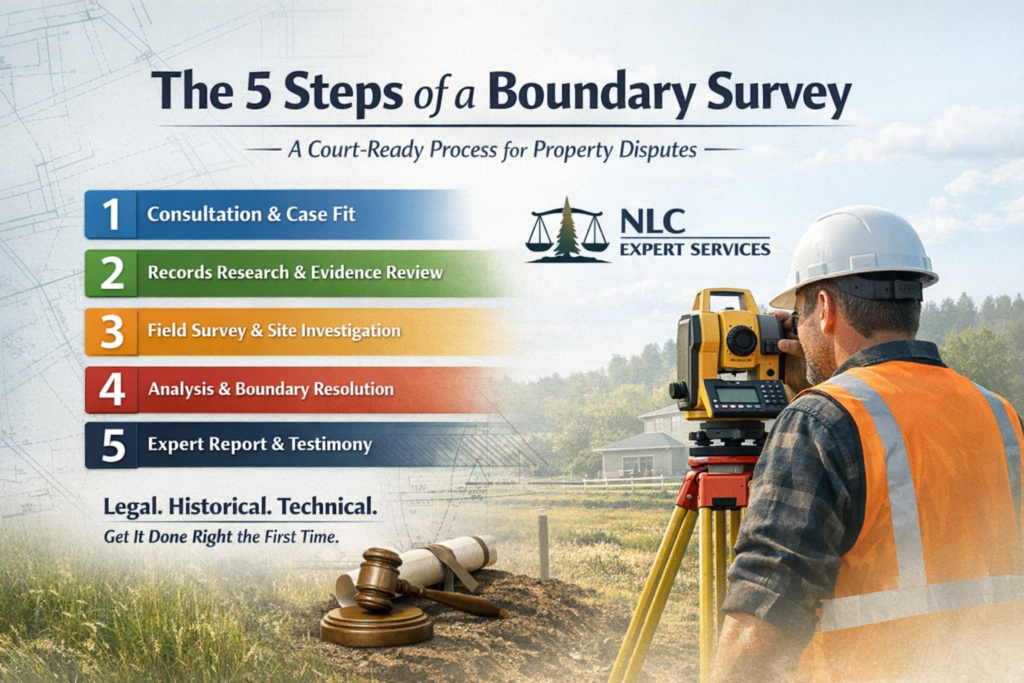
Boundary disputes don’t get resolved by simply “re-measuring a line.” A defensible boundary survey is a legal, historical, and technical investigation, one that connects record evidence to physical conditions on the ground and documents conclusions in a way that can withstand scrutiny.
Whether you are a property owner facing a dispute or an attorney preparing for litigation, understanding the boundary survey process is critical. Below, we break down the five core steps of a boundary survey and explain how NLC Expert Services approaches each phase when disputes escalate beyond routine surveying.
Step 1: Consultation and Case Fit
Before any survey work begins, the most important first step is determining the scope, timing, and whether expert services are appropriate.
What happens during this phase:
- Clarify the nature of the dispute (what is being contested and why)
- Identify litigation status and critical deadlines (discovery, hearings, trial)
- Review what documentation exists (deeds, plats, prior surveys, title work, pleadings)
- Determine the appropriate path forward:
- Proceed with expert services
- Proceed with a limited initial review
- Decline involvement if services would not add value
How NLC Expert Services approaches this step:
NLC begins with a free 30-minute consultation to understand the dispute, lawsuit status, and deadlines, and to determine whether expert services are appropriate.
Why this step matters:
For litigated disputes, the wrong scope or timing can weaken a case and waste resources. A structured consultation ensures that expert involvement strengthens, not complicates, the legal record.
Step 2: Records Research and Boundary Evidence Review
This is the phase most people underestimate. Boundary surveys are evidence-driven, not measurement-driven. The surveyor’s role is to retrace and interpret boundary intent using the best available record and physical evidence.
What is reviewed:
- Deeds, plats, conveyances, and related public records
- Easements, rights-of-way, and overlapping property interests
- If litigation is pending: pleadings, filings, and relevant case materials
- Title documents or commitments (when applicable)
- Prior surveys, monument records, and historical references
Boundary principles require that boundaries be established or retraced based on record and physical evidence, not assumptions.
How NLC Expert Services approaches this step:
NLC’s Stage I: Principles Phase includes a comprehensive document and literature review, full title reports when needed, and preparation of a working sketch by an experienced drafter to visualize the disputed area.
Practical expectation:
In complex disputes, this phase can take time. Records may span decades, jurisdictions, or conflicting sources. NLC notes that this phase can take up to 30 days and may involve reviewing thousands of pages.
For attorneys, this phase establishes the evidentiary foundation needed for defensible expert testimony.
Step 3: Field Survey and Site Investigation
Once the record picture is understood, the investigation moves to the field to collect physical evidence and measurements that support, or contradict, the records.
What happens in the field:
- Recovery or search for monuments and controlling boundary evidence
- Measurement of improvements and potential encroachments (fences, walls, structures)
- Documentation of conditions that help reconcile record vs. reality
- Use of modern surveying technology (GNSS, total stations, etc.)
Fieldwork alone does not determine a boundary; it provides the physical context needed to interpret the records accurately.
How NLC Expert Services approaches this step:
NLC’s Stage II: Practice Phase involves an on-the-ground boundary survey of all applicable parcels using advanced technology, with documented preparation including equipment calibration, crew confirmation, and logistical planning.
Step 4: Analysis, Boundary Resolution, and Mapping
This is where defensibility is won or lost. Data alone does not resolve boundaries; analysis does.
What analysis involves:
- Reconciling record calls with field evidence
- Evaluating conflicts such as overlaps, gaps, or senior/junior rights
- Applying boundary law principles to determine controlling evidence
- Producing a final survey map/plat and written conclusions
Boundary resolution requires disciplined reasoning and documentation that clearly explains how conclusions were reached.
How NLC Expert Services approaches this step:
NLC’s Stage III: Data Analysis, Map, and Report Phase integrates field data with record findings to produce the Survey Map and Expert Report. Each report includes dispute history, ownership history, factual analysis, and NLC’s expert opinion, reviewed with the attorney-client before signing and notarization.
Step 5: Expert Report Support, Testimony, and Resolution
In litigation, the survey is rarely the final step. The work must be clearly communicated, defended under questioning, and aligned with legal strategy.
This phase includes:
- Preparing an expert report that is understandable to non-surveyors
- Supporting counsel through depositions, hearings, and trial preparation
- Addressing opposing expert critiques
- Maintaining a consistent, defensible evidentiary record
How NLC Expert Services approaches this step:
NLC works closely with attorneys to prepare for deposition, hearing, or trial testimony and assists with preparation related to opposing experts. Once a settlement or judgment is entered, the expert engagement typically concludes.
Frequently Asked Questions
When do I need a boundary survey?
Common triggers include neighbor disputes, unclear or conflicting records, construction near a boundary, or preparing for legal action.
How is a boundary survey different from a mortgage or location survey?
A true boundary survey focuses on retracement, evidence, and defensible boundary resolution. Mortgage or location surveys are typically limited in scope and are not designed for disputes or litigation.
Why does a boundary survey take so long?
Because boundary determinations rely on evidence gathering and reconciliation, not just measurements. In disputed cases, records are often deep, conflicting, and time-intensive to analyze.
Need a Court-Ready Boundary Survey Process?
If you are already involved in a property dispute or litigation is likely, starting with a structured, expert-led process matters.
NLC Expert Services begins with a free consultation to determine fit and recommend the correct next step.
✅ Take the Quiz to see if you need an Expert Surveyor