
interested in AI in surveying?
Artificial intelligence (AI) is revolutionizing industries across the board, and land surveying is no exception. As a technical field that intersects with law, engineering, and real estate, land surveying relies heavily on data interpretation, spatial analysis, and regulatory expertise. Expert witnesses in this domain are called upon in litigation to offer professional opinions based on survey records, boundary determinations, and geospatial evidence. With the advent of AI, the traditional role of land survey expert witnesses is poised to undergo profound changes—both in how evidence is generated and how expert testimony is delivered in legal proceedings.
1. Automation of Survey Data Collection and Processing
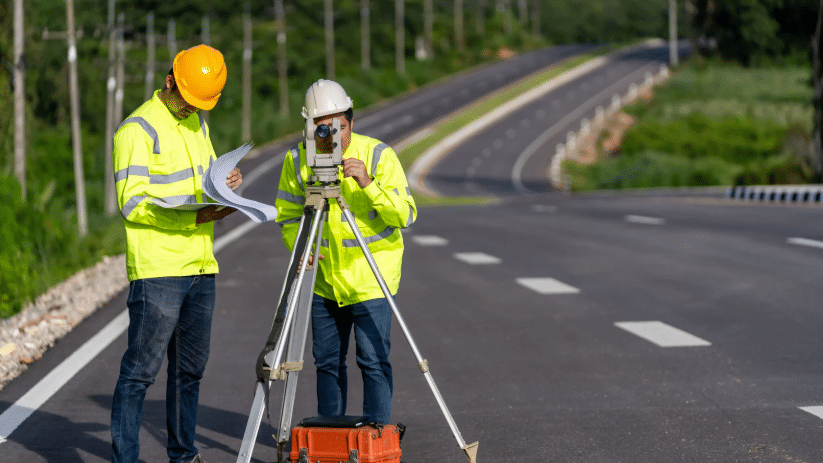
AI-enhanced technologies, particularly in the realm of drones, LiDAR (Light Detection and Ranging), and machine learning, have made it faster and more accurate to collect and process topographical and geospatial data. Traditionally, land surveyors had to conduct manual fieldwork, often in challenging terrain, to measure land boundaries and features. This process was time-consuming and susceptible to human error.
Today, AI algorithms integrated with drones and LiDAR systems can automatically detect land features, interpret terrain elevations, and create accurate 3D models of landscapes. These models can be processed and verified against cadastral data using AI to ensure compliance with legal records.
For expert witnesses, this means the evidence they bring into the courtroom will increasingly be generated or validated by AI systems. The shift from manual interpretation to AI-supported analysis changes not only how evidence is prepared but also how it is scrutinized in cross-examination. Expert witnesses will need to understand and be able to explain the underlying AI methodologies, including their strengths, limitations, and potential biases.
2. Improved Accuracy and Reduced Disputes
One of the major benefits AI brings to land surveying is improved accuracy. AI systems can analyze massive datasets, detect anomalies, and cross-reference historical land records with new geospatial data. As accuracy increases, there is a potential reduction in the number of boundary disputes that escalate to litigation. However, when disputes do occur, expert witnesses will be expected to explain why AI-generated data supports one legal interpretation over another.
In the courtroom, this could lead to a higher evidentiary standard for survey data. Attorneys and judges may come to expect data processed with AI-backed precision, and expert witnesses who fail to leverage such tools might see their credibility diminished. Conversely, experts who are proficient with AI technologies will be in higher demand for their ability to testify with the backing of more robust and error-resistant data.
3. Shift from Field Expertise to Data Literacy
Traditionally, the authority of a land survey expert witness was rooted in field experience—years of practical work with boundary determination, plat interpretation, and site inspections. With AI, there is a growing need for expertise in data science, machine learning, and geospatial analytics.
AI doesn’t eliminate the need for human interpretation, but it does shift the focus. Expert witnesses will increasingly be required to interpret AI-generated outputs, validate their accuracy, and explain technical methodologies to non-expert audiences such as juries and judges. This necessitates a hybrid skill set: deep knowledge of land surveying principles and fluency in the workings of AI algorithms.
Surveying professionals who wish to serve as expert witnesses in the future will benefit from education and training in AI tools and concepts, including neural networks, probabilistic modeling, and computer vision, which underpin many of the latest geospatial analysis tools.
4. AI in Forensic Surveying and Historical Data Analysis
AI’s capacity to sift through vast amounts of historical data can dramatically improve forensic surveying. In cases involving long-standing property disputes or unclear land titles, AI can be used to analyze old deeds, historical maps, aerial imagery, and previous survey records to reconstruct the most probable original boundaries.
Natural language processing (NLP), a subfield of AI, can automate the extraction of relevant information from legal descriptions and historical documents. Expert witnesses can use these AI-generated insights to build stronger, more comprehensive narratives about land ownership and boundary changes over time.
This capability not only increases the depth of analysis that an expert witness can offer but also democratizes access to historical data that might have otherwise been too costly or time-consuming to retrieve and analyze manually.
5. Enhanced Visualization and Communication Tools
AI-driven visualization tools such as augmented reality (AR) and 3D modeling software are becoming powerful aids in courtroom testimony. Rather than relying solely on verbal descriptions or 2D diagrams, expert witnesses can present dynamic, interactive models of disputed land parcels.
These models can incorporate layers of data: current and historical boundaries, topographical changes, easements, encroachments, and even projected environmental impacts. AI can enhance these visualizations by intelligently highlighting areas of conflict or change and simulating “what-if” scenarios based on various interpretations of boundary lines.
This evolution improves the persuasive power of expert testimony, making it easier for judges and juries to understand complex geospatial issues and increasing the impact of the witness’s narrative.
6. Challenges and Ethical Considerations
Despite its many benefits, the integration of AI into land surveying and expert witness testimony raises important challenges. One key concern is the “black box” problem: many AI models, especially deep learning systems, produce results without transparent decision-making processes. This opacity can make it difficult for expert witnesses to explain exactly how a particular output was derived, potentially undermining their credibility.
Moreover, bias in training data can lead to skewed outputs. If an AI system was trained predominantly on urban landscapes, for instance, its performance in rural or undeveloped areas might be less reliable. Expert witnesses must be aware of these limitations and be prepared to critically assess and explain them during testimony.
Legal admissibility is another area of concern. Courts may require a demonstration that AI-generated evidence meets standards such as the Daubert or Frye tests, which assess scientific validity and general acceptance. Expert witnesses must therefore not only understand the AI tools they use but also be able to establish their reliability and relevance in a legal context.
7. The Future: AI as a Collaborative Partner
Rather than replacing human experts, AI is more likely to become a collaborative partner in the land survey expert witness process. It can handle repetitive data processing, error detection, and visualization, allowing human experts to focus on interpretation, explanation, and ethical judgment.
In this new paradigm, the role of the land survey expert witness will evolve from that of a sole data provider to that of an informed interpreter and trusted guide through increasingly complex technological landscapes. Professionals who embrace this shift will find themselves at the forefront of a new era in forensic surveying and legal testimony.
AI in Surveying
The impact of artificial intelligence on land survey expert witnesses is both inevitable and transformative. From automating data collection and improving accuracy to reshaping how testimony is delivered and understood, AI is changing not just the tools of the trade but the nature of expertise itself. While challenges remain—in terms of legal admissibility, ethical transparency, and technological fluency—those who adapt to this new reality will play a pivotal role in the legal and technical adjudication of land-related disputes in the years to come.

0 Comments