
Premises Liability Case Study: The Hidden Hazard Between Two Parking Lots
In commercial real estate, the physical layout of customer-facing space carries real legal weight. Property owners, landlords and operators share an obligation to keep invitees safe from hidden, unreasonably dangerous conditions, and when a hazard sits on the boundary between two parcels, the question of who owed that duty becomes a surveying question. Dr. Tony Nettleman examines a Florida circuit court action arising from an unmarked vertical drop between two adjacent restaurant properties.
The Hidden Hazard
In the realm of commercial real estate and retail operations, the physical layout of customer-facing spaces carries immense legal responsibility. Property owners, landlords, and business operators share a collective obligation to ensure that invitees, those who enter premises for business purposes, are not subjected to hidden, unreasonably dangerous conditions.
When corporate negligence intersects with complex commercial property arrangements, the resulting litigation often involves intricate questions of duty, control, and causation. This case study examines a civil action filed in a Florida circuit court, highlighting the legal frameworks governing slip-and-fall and trip-and-fall accidents, multi-party liability, and loss of consortium claims.

Case Profile: Background and Key Players
On the evening of March 7, 2022, a local resident set out to pick up dinner for her family. Her errand involved visiting two adjacent fast-food establishments on adjoining parcels: a seafood restaurant and a sandwich shop.
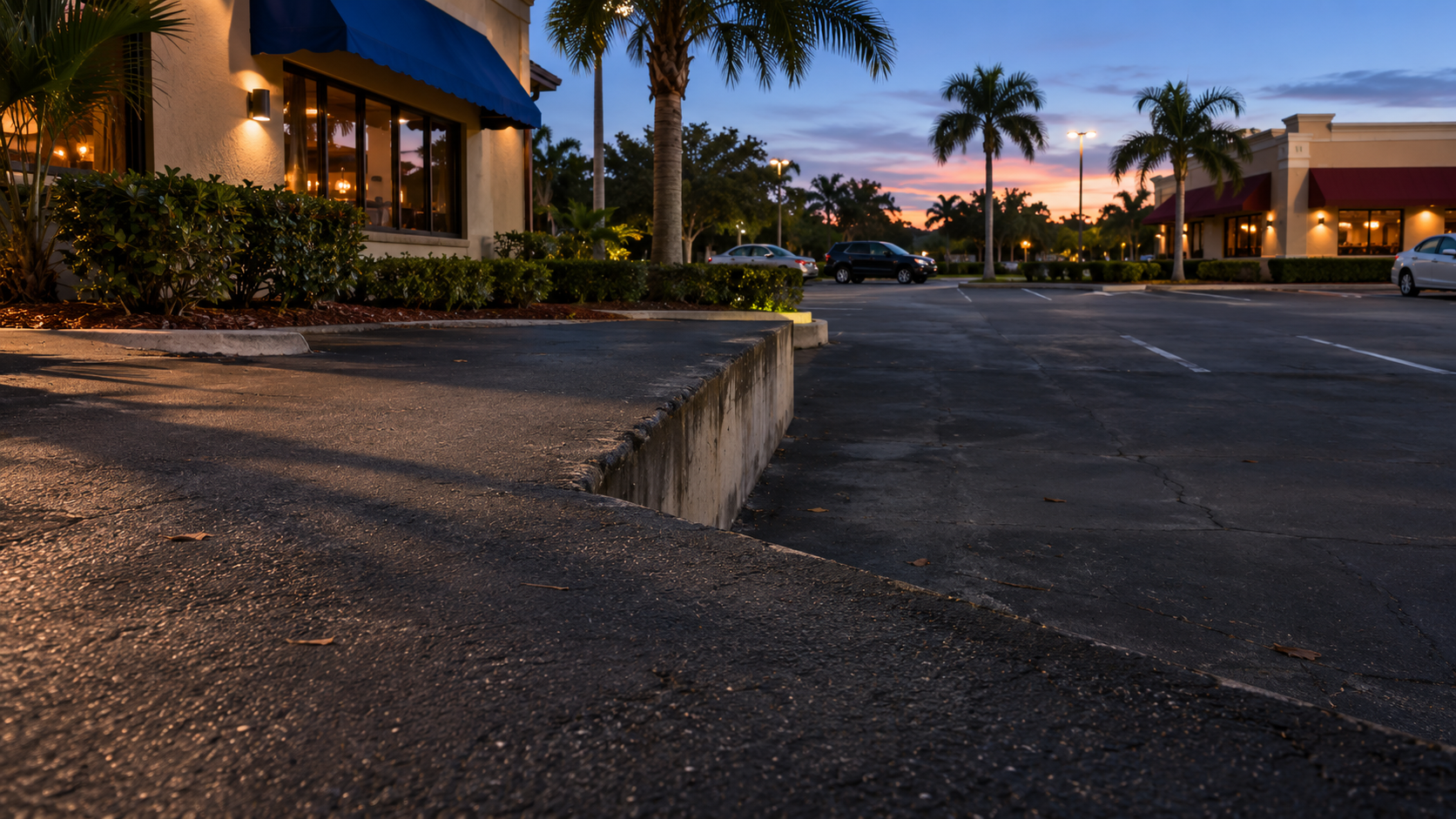
As she attempted to walk between the two properties, she encountered a severe, unmarked hazard in the transitional space between the two parking lots. The shared parking and pathway design incorporated an abrupt vertical drop, a ledge, whose height and presence were completely obscured from visual detection by approaching pedestrians under the existing evening lighting and environmental conditions.
She fell from the hidden ledge. The fall resulted in severe, debilitating physical injuries.
Because commercial properties are frequently encumbered by complex leasing structures, ground leases, and property management agreements, the plaintiff’s counsel filed suit not against a single corporate entity, but against a broad network of business operators, landowners, and property trusts. The lawsuit was structured around distinct counts of negligence against each corporate and trust defendant, alongside derivative claims for loss of consortium brought by the injured plaintiff’s spouse.

The Core Conflict: Who Owed the Duty?
Under Florida premises liability law, commercial establishments and landowners owe a non-delegable duty to business invitees. This means that even if a property owner hires third-party contractors, property managers, or leases space to commercial tenants, the fundamental legal duty to maintain the premises in a reasonably safe condition cannot be contracted away.
The complaint alleged that all defendants breached this duty by:
– Failing to ensure a safe, hazard-free environment for patrons walking between adjacent commercial lots.
– Approving or accepting a defective parking lot and walkway design featuring an unmarked, hidden vertical drop-off without safety barriers, handrails, or visual warnings.
– Failing to provide adequate lighting in the transitional areas between the two restaurant properties, rendering the hazardous ledge virtually invisible during evening hours.
– Failing to institute proper employee training programs to identify, report, or remediate hazardous physical conditions on the asphalt and walkways.
Direct Negligence and Failure to Warn
Property occupiers are legally required to warn invitees of known dangers that are not readily apparent or discoverable through ordinary observation. The plaintiff argued that because the ledge was situated directly along a natural walking path between two complementary food establishments, the defendants knew, or through the exercise of ordinary care should have known, that patrons would attempt to walk between the properties. By failing to install written warnings, painted safety lines, reflective markers, or physical barriers, the defendants created a deceptive environment that falsely represented the safety of the grounds.
The Core Technical Question
One of the central issues in this litigation was determining precise property ownership and control over the exact transitional area where the plaintiff fell. Because the incident occurred near the boundary lines separating adjacent parcels operated and owned by multiple distinct corporate entities and trusts, establishing who bore direct legal responsibility for maintaining that specific strip of land became critical.
A land surveying expert witness is essential in a case like this, conducting a thorough boundary analysis, reviewing historical plats and deeds, and accurately mapping where the property lines lie relative to the unmarked ledge. By establishing the exact metes and bounds, the surveyor’s expert testimony helps the court determine which defendant held the legal duty to maintain, light, or warn of the dangerous elevation change at that specific location.
Proximate Cause and Damages
To recover in a negligence action, a plaintiff must prove that the defendant’s breach was the direct and proximate cause of their injuries. The complaint asserted that the structural hazard directly caused the fall, resulting in extensive damages:
– Severe bodily injury, physical pain and suffering, and permanent disability.
– Mental anguish, emotional distress, and loss of the capacity for the enjoyment of life.
– Past and future medical, hospital, and nursing expenses.
– Lost wages and a diminished future earning capacity.
– Aggravation of any pre-existing medical conditions, where applicable.


Key Takeaways and Lessons
The Danger of Inter-Parcel Boundaries.
Commercial developments that feature closely packed retail pads or shared parking fields frequently encounter liability blind spots where separate property parcels meet. Designers and landowners must account for pedestrian traffic patterns that cross property lines.
The Importance of Environmental Cues.
Changes in elevation, retaining walls, and parking lot drops must be clearly demarcated with high-visibility paint, adequate pole or bollard lighting, and physical barriers to ensure visibility.
Multi-Party Exposure.
When an injury occurs near a property boundary, injured plaintiffs will typically cast a wide legal net, suing all adjacent landowners, tenants, and management entities. This forces defendants to litigate internal lease responsibilities, indemnification clauses, and allocation of control alongside the core defense against the plaintiff’s claims.

What This Means for Business Owners and Real Estate Counsel
The lawsuit demanded a trial by jury and sought damages above the court’s jurisdictional threshold, exclusive of interest and costs.
For counsel on either side, the boundary question comes first. Until the property line is established with precision, every other argument, duty, control, lease allocation, and indemnification rests on an assumption. For owners and operators, the lesson is simpler: the edges of your parcel are exactly where your exposure is highest, and they are the part of the site least likely to have been reviewed.
Why Choose NLC for Land Disputes?
We Deliver:
Comprehensive survey principles applied to real-world cases
Precise field measurements and thorough documentation
Clear communication of complex data to all parties involved

If you’re seeking facts and precision in your boundary, title, or easement dispute, NLC is here to help.

Dr. Tony Nettleman
Dr. Nettleman is a land surveyor, author, educator, and expert witness.