
The Invisible Battle for the Horizon:
When Your Neighbor’s Dock Steals Your Waterfront View
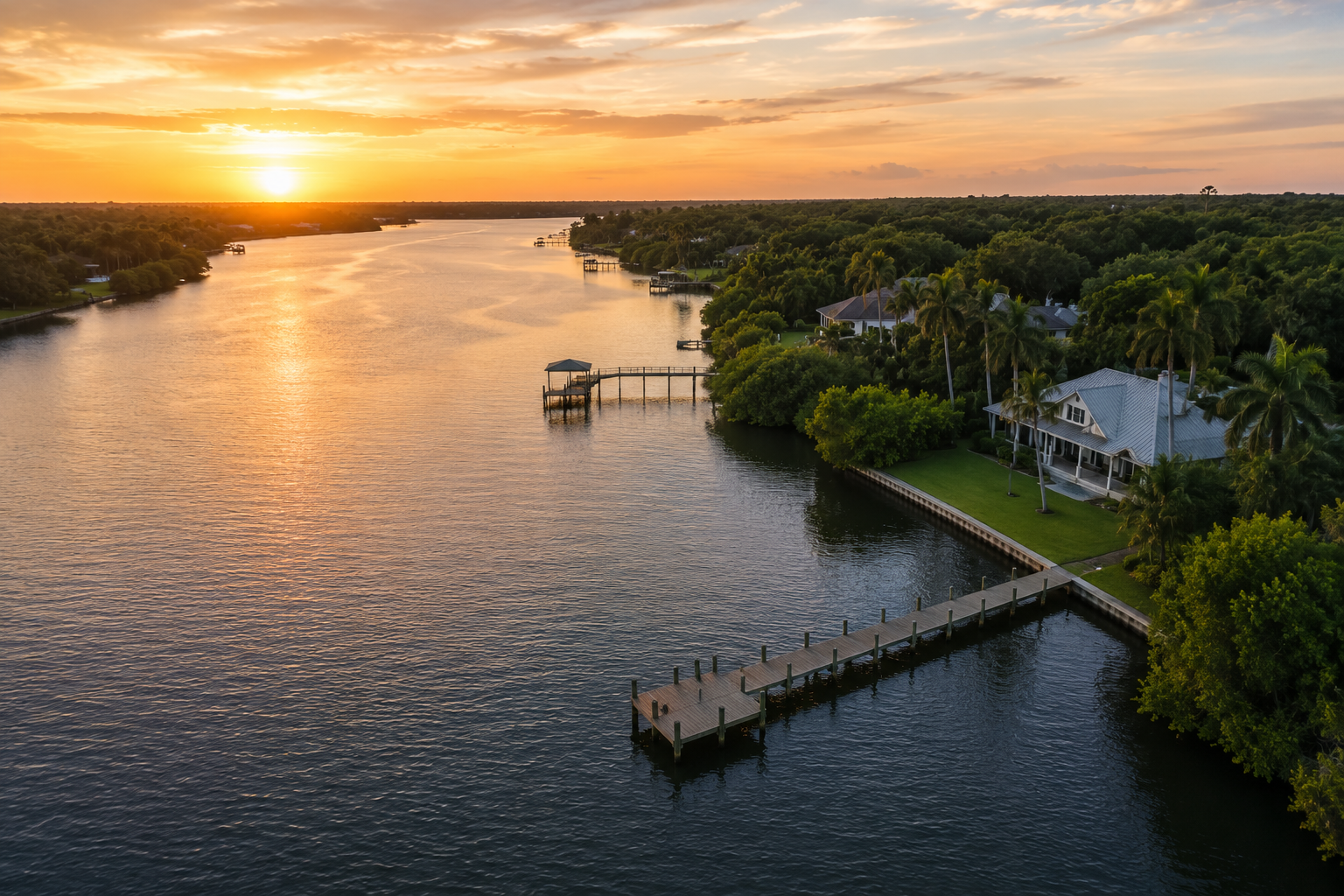
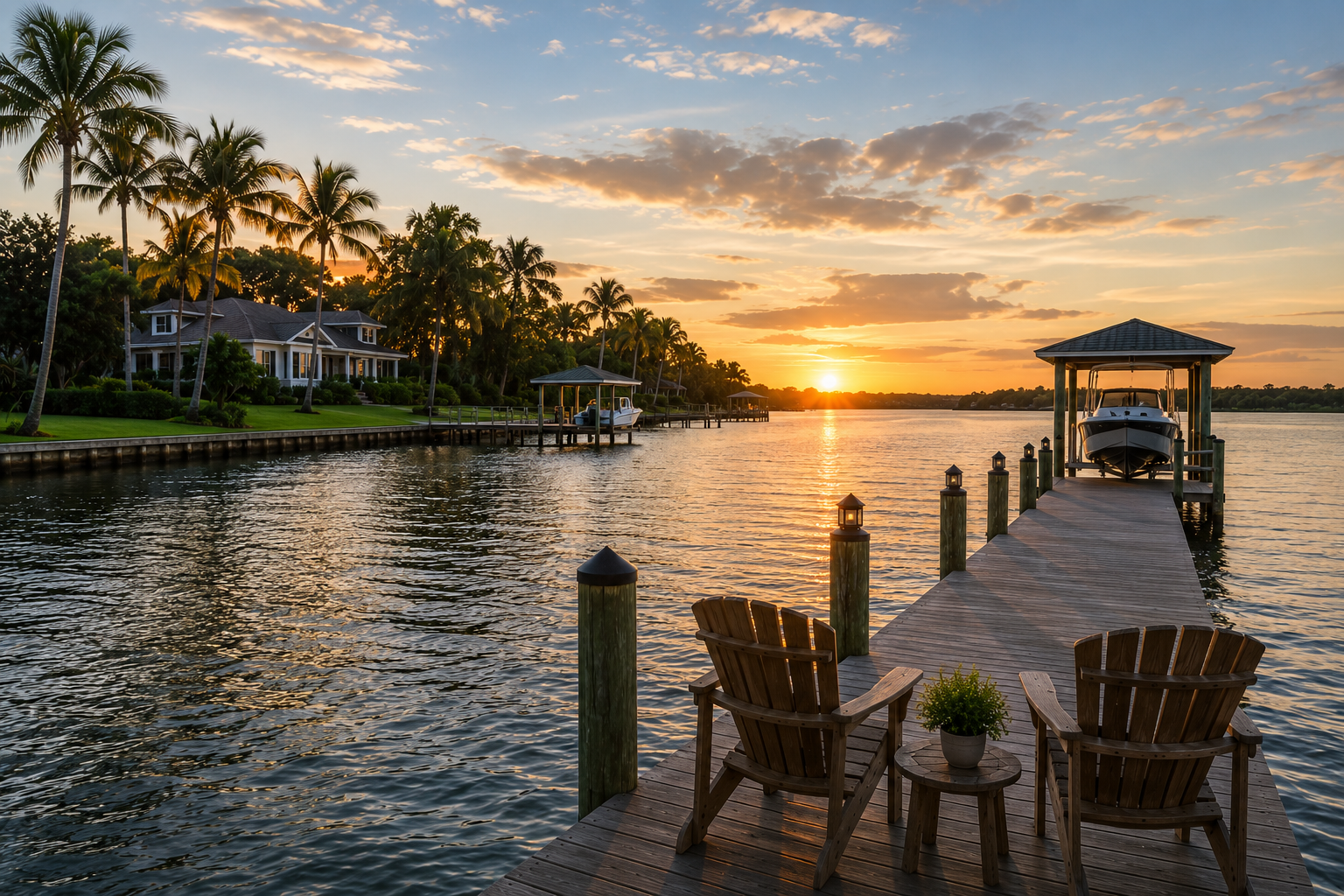
This case study examines a waterfront dispute on the East Fork of the Loxahatchee River in Florida, where a neighbor’s angled riparian line and 400-foot dock threatened to permanently obstruct an established homeowner’s panoramic river view.
The Allure of the Unobstructed Vista
In 2018, homeowners John and Jane Doe carefully constructed a 300-foot dock designed to harmonize with their property and existing riparian boundaries on the East Fork of the Loxahatchee River. At the time, their neighbor to the south was a vacant lot — a quiet stretch of shoreline that offered no competition for the waterfront view that defines Florida riverfront living.
That peace was disrupted when the vacant lot was purchased by the Weston family trust in early 2020. The new owner didn’t just want a dock — they wanted a massive, 400-foot structure equipped with dual boat lifts.
What followed was a legal battle not over who owned the water, but over who had the right to see it.
The Core Issue: Who Controls the View?
The dispute centered around one critical question:
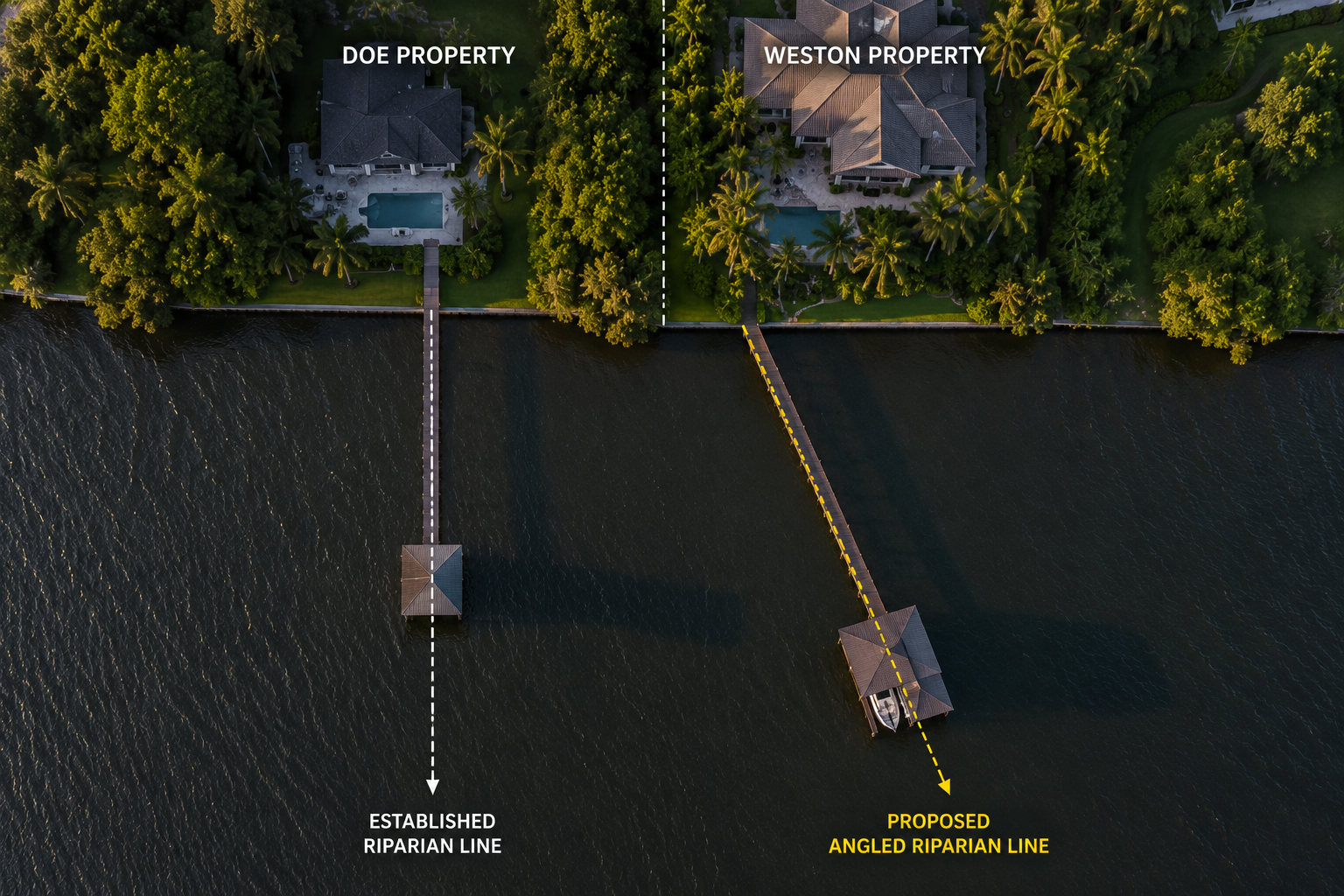
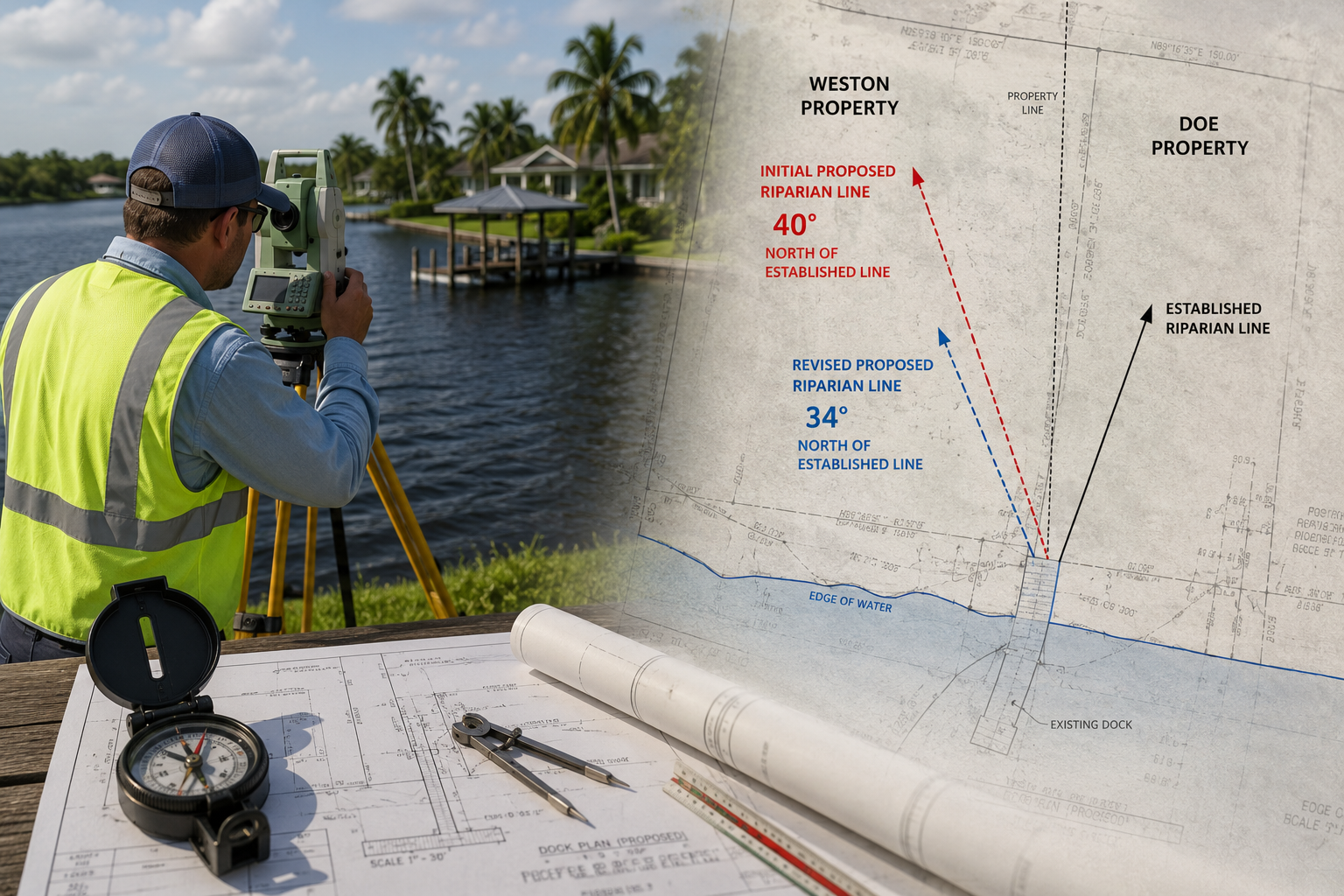
Did the Weston family trust have the right to angle their dock northward into the Does’ riparian area, or were they legally required to follow the established boundary lines?
Two conflicting positions emerged:
– The Westons argued their riparian line justified the angled dock placement, keeping their own lot unobstructed while maximizing their waterfront view.
– The Does asserted that the angled line was a strategic deviation — not a legitimate survey boundary — designed to appropriate their waterfront horizon at the Does’ expense.
This created a direct conflict between established riparian boundaries and claimed survey methodology.
The Legal Framework: Drawing the Line in the Water
1. Riparian Lines Must Follow Upland Boundaries
The court examined the survey methodology used to establish the Westons’ riparian line. Under Florida riparian law, water boundary lines are generally drawn perpendicular to or following the natural angle of the shoreline — not angled to benefit one party at the expense of another.
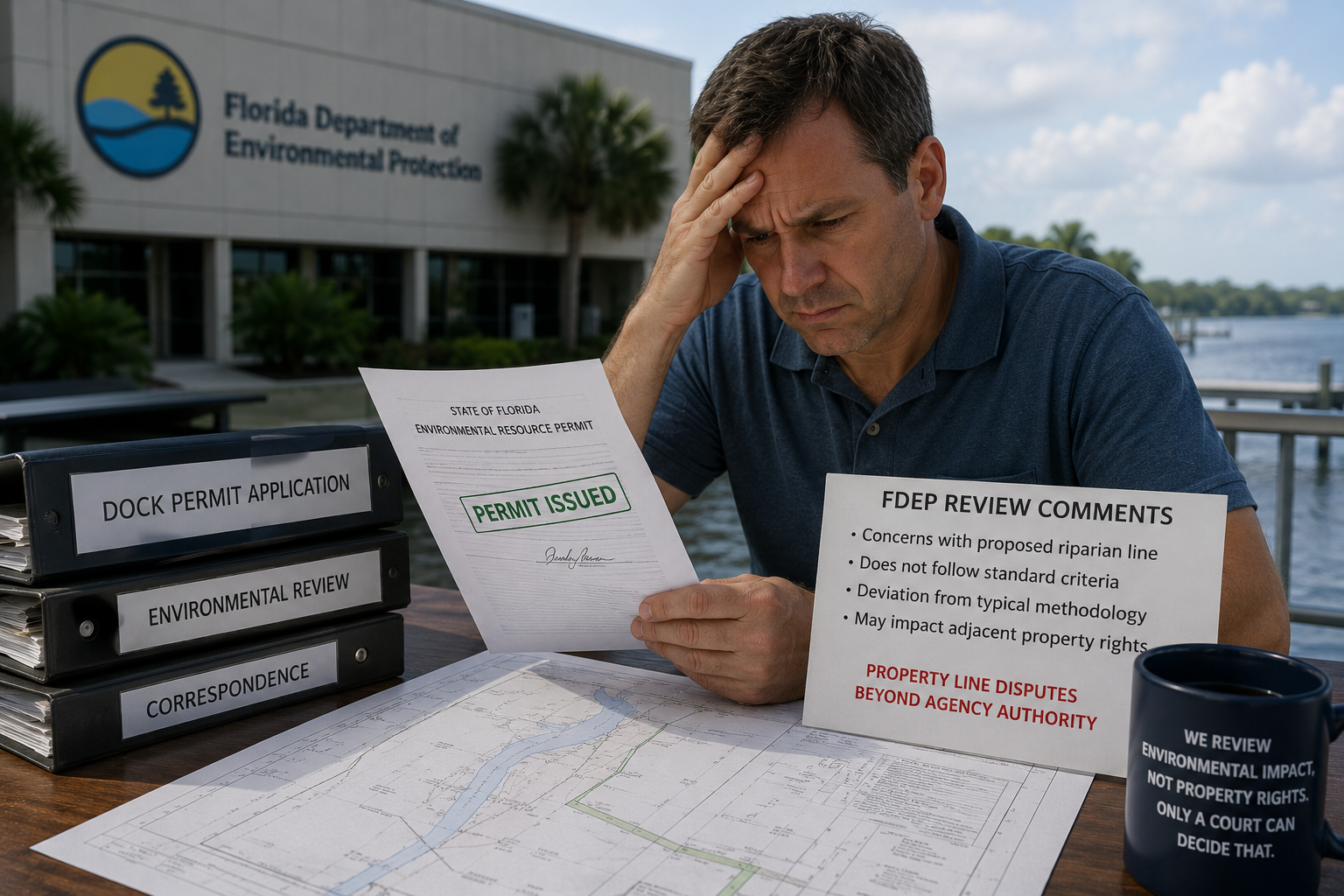
The proposed 40-degree deviation — and even the revised 34-degree deviation — did not conform to standard criteria, a fact acknowledged by the Florida Department of Environmental Protection during permit review.
2. The Regulatory Gap
A critical issue emerged:
The Outcome
The parties reached a settlement in 2023. The case established several critical points for waterfront property owners and litigation counsel:
– Riparian lines must conform to established survey methodology, not be drawn to benefit one party’s view at another’s expense
– State agencies like FDEP can identify non-conforming riparian lines but cannot resolve the underlying property dispute — only a court can
– The angle of a dock relative to a neighbor’s riparian area is a legally significant survey question, not merely an aesthetic one.
What This Means for Property Owners
Riparian Lines Are Not Arbitrary
How a riparian line is drawn — its angle, its reference point, its conformity to shoreline standards — determines who controls the water in front of their property. A line drawn incorrectly, even professionally, can be challenged in court.
The Regulatory Gap Is Real
State permitting agencies review environmental impact, not property rights. A dock can receive a permit and still be legally infringing on a neighbor’s riparian area. Permit approval is not legal clearance.
Your View Has Legal Value
In waterfront communities, an unobstructed view is a quantifiable property asset. When a neighbor’s structure eliminates that view, it may constitute legally actionable obstruction regardless of whether the structure itself sits on their own property.
Need Help Interpreting Property Rights?
Understanding deeds, boundary rights, and legal land ownership can be complex. Our team provides expert analysis and support for disputes involving:
– Riparian boundary disputes
– Dock encroachment and obstruction claims
– Waterfront view obstruction
– Survey methodology and standard of care
– Florida waterfront property conflicts
Why Choose NLC for Land Disputes?
We Deliver:
Comprehensive survey principles applied to real-world cases
Precise field measurements and thorough documentation
Clear communication of complex data to all parties involved

If you’re seeking facts and precision in your boundary, title, or easement dispute, NLC is here to help.

Dr. Tony Nettleman
Dr. Nettleman is a land surveyor, author, educator, and expert witness.