


Two fundamental legal concepts govern the rights of landowners: littoral rights and riparian rights. This is the case for property ownership and water access, particularly for those of you in the State of Florida.
These rights dictate how property owners can use and access adjacent bodies of water. It also plays a significant role in real estate law and land development. Understanding the distinction between the two is essential for property buyers, developers, and legal professionals.
Riparian Rights
Riparian rights pertain to landowners whose property is adjacent to a moving body of water, such as rivers, streams, or creeks. These rights grant the landowner the ability to make reasonable use of the water for domestic, agricultural, or recreational purposes. However, their use should not interfere with the rights of other riparian landowners or harm the ecosystem. Riparian rights are often associated with the natural flow of the water so it remains undisturbed for all adjoining properties.
Littoral Rights
Littoral rights apply to landowners whose property borders large, static bodies of water, such as lakes, oceans, or seas. These rights generally extend to the high-water mark of the body of water. This means the landowner does not own the water itself but has the right to access and enjoy it.
Littoral rights ensure that property owners can engage in activities such as boating, fishing, or swimming without obstruction from others. However, public access and government regulations can sometimes limit these rights.
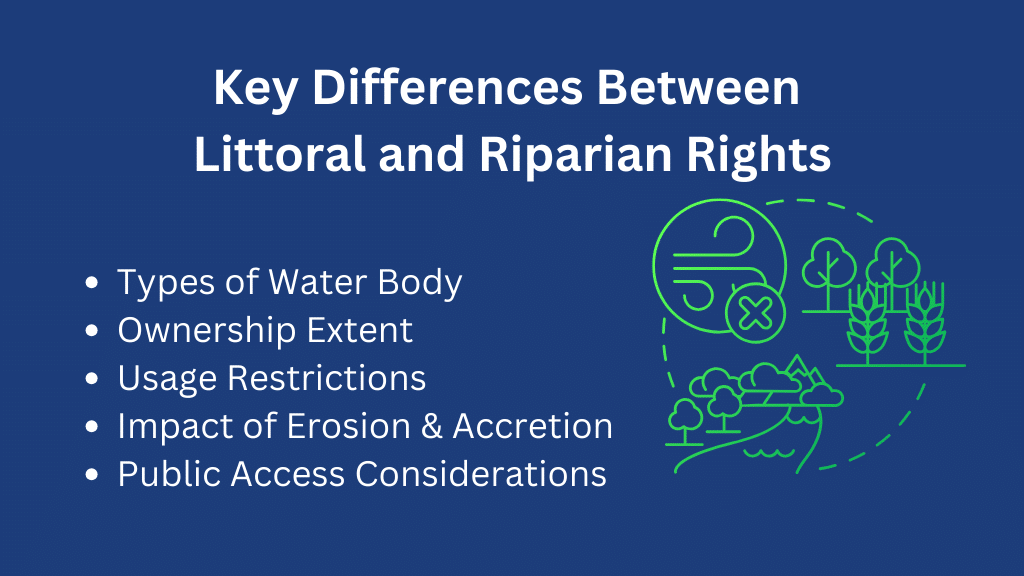
Key Differences Between Littoral and Riparian Rights
1. Type of Water Body
- Riparian Rights: Apply to properties adjacent to flowing bodies of water such as rivers, streams, or creeks.
- Littoral Rights: Apply to properties adjacent to non-flowing, large bodies of water such as lakes, oceans, or seas.
2. Ownership Extent
- Riparian Rights: The landowner typically owns the land beneath the water to the centerline of the waterway (if the body of water is non-navigable). If the water is navigable, ownership usually stops at the high-water mark. Conversely, the state or government owns the submerged land.
- Littoral Rights: The landowner’s rights typically extend only to the high-water mark. The government usually owns the land beyond that point, such as the seabed or lakebed.
3. Usage Restrictions
- Riparian Rights: Allow for direct usage of water for personal, agricultural, or business purposes. This is provided that the use does not significantly alter the natural flow or harm other landowners.
- Littoral Rights: Primarily grant access to the water rather than the ability to alter or use the water directly for consumption or business purposes.
4. Impact of Erosion and Accretion
- Riparian Rights: If the river or stream naturally shifts due to erosion or accretion, the landowner’s property line may also shift accordingly.
- Littoral Rights: The high-water mark determines the boundary. If the shoreline moves, the boundary may also move. However, ownership of submerged land remains with the government.
5. Public Access Considerations
- Riparian Rights: In some cases, navigable waterways are considered public. This means others may have the right to travel through them. Despite this, the landowner still has rights to use and access the water adjacent to their property.
- Littoral Rights: Coastal landowners may have to contend with public access laws. This is because beaches and shorelines are often designated as public land, which restrict the ability to exclude others.
Riparian and littoral rights provide property owners with valuable privileges. However, these rights are subject to legal limitations, environmental regulations, and government policies. Local, state, and federal laws may restrict how a landowner can use or modify water resources. Additionally, environmental protections such as the Clean Water Act can influence how these rights are exercised to preserve ecosystems and public interests.
Disputes over these rights often arise. For instance, when one party attempts to alter water flow, restrict access, or claim ownership beyond what is legally permitted. Courts typically balance individual property rights with environmental and public interests when resolving such disputes.
Knowing the difference between littoral and riparian rights is crucial for property owners, developers, and investors who deal with waterfront properties. Both sets of rights grant certain privileges regarding water access and usage. Where they differ lies in the type of water body involved, the extent of ownership, and the restrictions imposed. Whether one owns property along a flowing river or a tranquil lake, being aware of these distinctions ensures responsible and lawful utilization of water resources.
NLC has successfully assisted dozens of property owners in the State of Florida (and elsewhere) in understanding their rights as owners of waterfront properties. Contact NLC today for more information!