

MOMModerLand surveying is long rooted in tradition and meticulous manual work. Today, it’s undergoing a seismic transformation thanks to advancements in artificial intelligence (AI).
AI is enhancing the accuracy and efficiency of land survey processes and each surveying instrument. At the same time, it’s redefining the role of land surveyors and expanding the “boundaries” of what is possible.
In this Blog, NLC looks at how AI is revolutionizing land surveying, its benefits, challenges, and future implications.
The Traditional Landscape of Land Surveying
Historically, land surveying has relied on tools such as theodolites, levels, and measuring tapes. These were necessary to collect data about land features and boundaries.
The advent of new technologies like GPS (Global Positioning System) and Geographic Information Systems (GIS) modernized the field. However, the processes remained labor-intensive, time-consuming, and subject to human error.
Land surveyors spend significant time on-site, often working in challenging conditions to gather accurate measurements. Advanced surveying technology such as laser scanning compliments a professional land surveyor’s expertise in providing an accurate measurement.
AI’s Emergence in Modern Land Surveying
AI is disrupting traditional surveying methodologies through automation, machine learning, and advanced data analytics. It’s contributing to modern land surveying techniques that are more precise and less labor-intensive. With AI, surveyors can speed up tasks from data collection and processing to interpretation and decision-making.
Applications of AI in Land Surveying
-
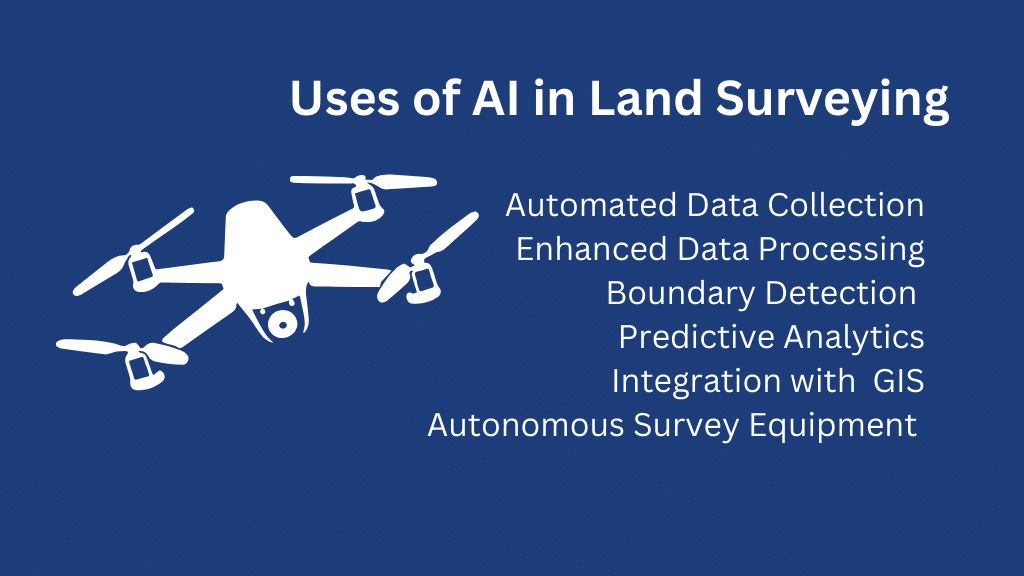
Automated Data Collection
The integration of AI with drones and LiDAR (Light Detection and Ranging) systems has revolutionized data collection. Drones equipped with AI-powered sensors can capture high-resolution aerial imagery and topographic data.
The process takes a fraction of the time required by traditional methods. AI algorithms process this data in real-time. It can identify key features such as land boundaries, elevations, and vegetation coverage with remarkable accuracy.
-
Enhanced Data Processing
Machine learning models can quickly analyze massive datasets collected from drones, LiDAR, and GPS. AI can identify patterns, detect anomalies, and generate 3D models and maps automatically. This reduces the time spent on post-processing and minimizes the likelihood of errors caused by manual interpretation.
-
Boundary Detection and Legal Compliance
Determining property boundaries is a critical aspect of land surveying. AI-powered systems can analyze historical survey data, satellite imagery, and legal documents to identify and validate property lines. This ensures compliance with zoning laws and reduces disputes over boundaries.
-
Predictive Analytics
AI can predict changes in land use, erosion patterns, and environmental impacts by analyzing historical and real-time data. These insights are invaluable for urban planning, construction projects, and environmental conservation efforts.
-
Integration with GIS
GIS platforms powered by AI can provide dynamic, interactive maps that update in real time. Land surveyors and stakeholders can use these maps to visualize land features. They’re also used to simulate development scenarios and make data-driven decisions.
-
Autonomous Survey Equipment
Robotic total stations and autonomous vehicles equipped with AI are now being used for on-site measurements. These devices can navigate rough terrain, collect data autonomously, and communicate with central systems. This reduces the need for human presence in hazardous areas.
Benefits of AI in Land Surveying
-
Increased Accuracy
AI reduces human errors in data collection and processing. As such, surveyors can produce highly accurate measurements and analyses. This is particularly important in infrastructure development projects and land boundary disputes.
-
Enhanced Efficiency
AI-powered tools can complete tasks much faster than traditional methods. This allows surveyors to handle more projects simultaneously for higher productivity.
-
Cost Savings
By automating labor-intensive processes, AI reduces the need for extensive human involvement. The result is significant cost savings in terms of time, manpower, and resources.
-
Improved Safety
Surveyors often work in challenging environments, such as construction sites, mountainous terrains, and disaster-prone areas. AI-powered drones and autonomous vehicles can perform these tasks to minimize human safety risks.
-
Better Decision-Making
AI’s ability to process and analyze data in real time provides surveyors and stakeholders with actionable insights. This supports more informed decision-making, whether it’s planning a construction project or managing natural resources.
Challenges of AI Implementation
While AI offers numerous benefits, its adoption in land surveying comes with challenges:
-
High Initial Costs
Implementing AI technologies requires significant investment in equipment, software, and training. Smaller surveying firms may find these costs prohibitive.
-
Data Privacy and Security
The use of AI involves collecting and storing large amounts of sensitive data. Ensuring data privacy and protecting against cyber threats are critical concerns.
-
Skill Gap
The integration of AI necessitates new skills in data analytics, programming, and machine learning. Many surveyors may need retraining to adapt.
-
Regulatory and Ethical Issues
The use of AI in boundary detection and legal compliance raises questions about accountability and ethical considerations. Regulations need to evolve to address these challenges.
-
Dependence on Technology
Over-reliance on AI could lead to potential issues if systems fail or produce inaccurate results. Maintaining a balance between automation and human oversight is essential.
The Future of AI in Land Surveying
The role of AI in land surveying is expected to grow exponentially in the coming years. Modern surveying technology like edge computing, augmented reality (AR), and blockchain will further enhance AI’s capabilities in the field.
-
Real-Time Collaboration
AI-powered platforms will enable real-time collaboration between surveyors, engineers, architects, and other stakeholders. Cloud-based solutions will make it easier to share and analyze data from anywhere in the world.
-
Sustainable Practices
AI can contribute to sustainable development by optimizing land use and minimizing environmental impact. Predictive models can identify potential risks and suggest mitigation strategies before construction begins.
-
Personalized Solutions
With advancements in AI, a land surveyor will be able to offer more customized solutions for specific projects. This includes generating detailed reports, simulating outcomes, and providing recommendations based on site conditions.
-
AI-Driven Regulations
Governments and regulatory bodies will likely incorporate AI for approval processes. It will help in securing compliance with zoning laws and environmental standards.
Modern Land Surveying Benefits
AI is undeniably reshaping the land surveying profession. It’s bringing a paradigm shift in how land is measured, analyzed, and managed. While challenges remain, the benefits of AI may possibly outweigh its drawbacks. Boundary survey processes will benefit from increased accuracy and efficiency, and enhanced safety and sustainability.
As technology continues to evolve, a surveyor who embraces AI will be at the forefront of innovation. Taking advantage of AI’s potential will help the land surveying profession reach new levels of precision and efficiency.


0 Comments