
The intake call with a prospective surveying expert is short and it is the most leverage you will have in the entire engagement. These are the questions worth spending it on, and what you are actually listening for in each answer.
On Credentials
“Which states are you licensed in, and have you practiced under this state’s boundary law?”
Holding a license and having litigated under a state’s doctrine are different. Florida’s treatment of riparian boundaries, Texas’s history of Spanish and Mexican land grants, California’s approach to coastal boundaries, these are not details an expert picks up from the reciprocity exam.
“Have you published in this field?”
Published work is external verification of expertise. Textbooks, professional journals, continuing education instruction. In a close case, an expert who authored the authority the court is applying occupies ground that is difficult to attack.
On Litigation Experience
“How many times have you been deposed? How many times have you testified at trial or in arbitration?”
You want numbers. Deposition experience and trial experience are different skills, plenty of experts have been deposed often and testified rarely, because most cases settle. If yours is likely to try, the trial number matters more.
“Have you been retained by both plaintiffs and defendants?”
An expert who only works one side has a pattern, and opposing counsel will put it in front of the jury. Balanced engagement history is a credibility asset, not a neutral fact.
“Has your testimony ever been excluded, limited, or successfully challenged?”
Ask it directly and listen to how it lands. A single exclusion with a clear explanation is not disqualifying. Evasion is. And you need the answer before opposing counsel finds it, because they will.
On Your Specific Case
“How many matters like this have you handled?”
Surveying litigation covers ground that has less overlap than it appears. A retracement dispute, a prescriptive easement claim, a surveyor negligence action, and a construction defect involving grading require different analysis and different familiarity with the applicable standards.
“Based on what I have described, what is your preliminary read?”
This is the most revealing question on the list. You are not looking for agreement. You are looking for an expert who will tell you what the evidence appears to support, including the parts that do not help you. An expert who adopts your theory before reviewing a single document will abandon it just as readily when the records come back.
“What documents would you need, and what might be missing?”
A good answer here is specific and it is useful immediately, it tells you what to request in discovery. An expert who cannot answer it has not thought about your case yet.
On Process and Timeline
“When could you begin, and how long does your analysis typically take?”
Expect records research to take weeks, not days, on any matter with a deep chain of title. Field work has to be scheduled and may require access negotiation. If the answer to this question does not fit your disclosure deadline, better to know now.
“What does your engagement include?”
Written report, survey map, exhibits, deposition, trial testimony, attorney review sessions, rebuttal of the opposing expert. Establish which of these are in scope and which are billed separately.
“How do you handle conflicts?”
A conflict check before formal engagement should be routine. If it is not part of their process, that tells you how much litigation work they actually do.
On Communication
“Walk me through how you would approach this.”
This is the jury test, run early. If the expert cannot explain their methodology to you — an attorney, motivated, with context, in terms you follow, they will not be able to explain it to twelve people who have never seen a plat.
Technical competence and the ability to teach are separate skills. The second one is the one that decides cases.
“Can you show me an example of your exhibits?”
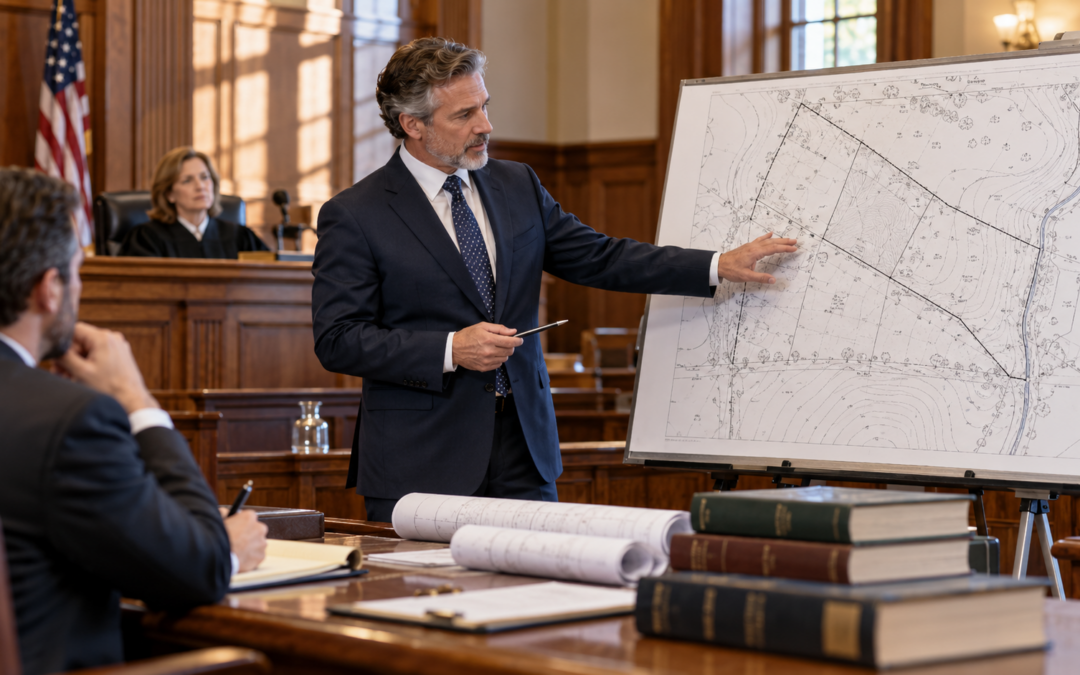
Ask to see redacted work product if they have it. Exhibits are where a surveying opinion becomes comprehensible to a fact-finder, and the quality varies enormously. A technically correct drawing that a jury cannot read has failed.
What You Are Really Assessing
Underneath all of these there are three questions.
Can this person reach a defensible conclusion? That is methodology, records discipline, and depth in the specific dispute type.
Will the conclusion survive challenge? That is admissibility record, repeatable method, and opinions scoped no broader than the evidence.
Can a jury follow it? That is the one most attorneys underweight and the one that most often decides the outcome.
An expert who clears all three is worth waiting for. An expert who clears two is a risk you should take knowingly.
Considering a surveying expert for a boundary, easement, or title matter? Schedule a free 30-minute consultation with Dr. Tony Nettleman, no obligation, and not every case requires expert services.
0 Comments