
In property litigation, a qualified surveyor expert witness often determines whether a boundary or title case settles favorably or collapses under a Daubert challenge. Many boundary and title disputes resolve before the first witness takes the stand, and the survey evidence is frequently the reason why. The methodology either holds or it does not, and if the expert cannot survive a Daubert motion, the rest of the case is in serious jeopardy.
The problem is that finding a qualified surveyor expert witness, one who is technically credible, procedurally clean, and ready for a courtroom, is harder than most attorneys expect. The gap between a licensed surveyor and a defensible expert is real and wide. This article gives you a practical framework: what a surveying expert does, how to vet and retain one, what deliverables to expect, and how to identify weaknesses in the opposing expert’s work. For attorneys who need an expert when the stakes are high, NLC / Tony Nettleman Land Surveying Expert Witness is the firm that keeps showing up in that conversation.
What a surveyor expert witness actually does in property litigation
A surveyor expert witness is not a neutral fact witness who reads a plat to the jury. This expert forms opinions, defends a methodology under cross-examination, and translates decades of deed history into evidence a judge or jury can follow. The role requires deep technical knowledge and the discipline to hold a position when opposing counsel pushes back hard.
The core case categories that require dedicated survey expertise include:
- Boundary disputesinvolving conflicting deed calls, monument conflicts, and senior/junior rights
- Easement and title conflictscovering access rights and deed interpretation
- Water rights and riparian disputes, which can carry substantial complexity depending on the jurisdiction
- Surveyor negligence caseswhere the question is whether another professional’s work met the applicable standard of care
- Construction defect mattersinvolving grading errors, encroachments, and site plan discrepancies
The expert’s workflow starts with pulling deed records, plats, and title reports, then moves to field surveys and historical record analysis. The result is a reproducible opinion: one that another qualified surveyor reviewing the same data would reach through the same process, even if the two experts disagree on the conclusion. Reproducibility is not a bonus here. It is the baseline Daubert demands.
The Daubert standard and what it demands from your expert
Federal courts require expert testimony to be grounded in sufficient facts, a reliable methodology, and a reliable application of that methodology to the specific case. Many state courts apply similar standards, though some still follow Frye or their own state-specific rules, so jurisdictional requirements are worth confirming early. For surveying experts, none of this is abstract philosophy. A sloppy field survey, an unreferenced calculation, or a credential the expert cannot substantiate gives opposing counsel exactly what they need for a motion to exclude.
Credentials must be verifiable and current. Courts look for an active professional land surveyor license in the relevant jurisdiction and specialized training or certification matched to the dispute type. Authorship of recognized boundary law texts and current membership in professional bodies are persuasive indicators of expertise, though not universal legal requirements. Any license gap, board discipline, or expired certification will be found by opposing counsel before deposition. Count on it.
Methodology is the real test under Daubert. The core question is whether the expert’s method can be tested and replicated. For survey experts, that means documented field measurements, cited standards such as ALTA/NSPS or applicable state minimum technical standards, clear calculation chains, and an opinion that does not depend on a single document or a single interpretation. Well-documented methodology is what separates an expert who survives cross-examination from one who collapses under it.
A clean challenge history is more valuable than credentials alone. A surveyor with twenty years of experience and prior Daubert exclusions is a liability, regardless of the CV. When vetting your surveyor expert witness, ask specifically about prior challenges and get the case citations. Opposing counsel will research your expert before deposition, and you want them to find a record that holds up.
How to vet and retain the right surveyor expert witness for your case
Attorneys often rush this step, particularly on tight litigation timelines. Thorough vetting before retention prevents problems at deposition and at a Daubert hearing six months into the case. Those checks done upfront are worth far more than damage control later.
- Verify current licensureand confirm no board discipline or complaints in the relevant state or states.
- Review prior deposition and trial testimony for exclusions, limitations, or judicial criticism.
- Audit the CV against primary sources: degrees, employers, publication credits, and certifications.
- Confirm direct experience with the specific dispute type. Boundary, water rights, and surveyor negligence cases are not interchangeable specialties.
- Run a conflict check and get it in writing before sharing case documents.
Understanding surveyor expert witness fees
On fees: qualified land surveying expert witnesses commonly bill in the range of $150 to $400 per hour, with highly credentialed experts in complex matters reaching $400 to $675 per hour for deposition and trial testimony. Case review, report preparation, deposition, and trial are typically scoped and billed separately. Total case costs can run from $2,500 to $25,000 or more depending on complexity. Most experts require a retainer before beginning work, so build that into your timeline early.
Engagement speed matters as much as credentials when you have active litigation. Ask specifically how quickly the expert can review materials and produce a written opinion. NLC provides land surveyor litigation support across plaintiff, defense, and neutral expert roles, which means the firm is not arriving with a predetermined outcome. Dr. Nettleman holds professional licensure across multiple states and is a co-author of recognized boundary law texts. The scope of engagement covers case document review, field survey when warranted, a written expert report, and courtroom exhibit preparation built in coordination with retaining counsel.
Deliverables attorneys should expect from a qualified survey expert
A qualified surveying expert does not deliver a verbal opinion and a rough sketch. The deliverable set should be organized, exhibit-ready, and defensible under cross-examination. Anything less creates problems you will have to solve under time pressure.
The written expert report
The written expert report is the foundation. Under Federal Rule 26(a)(2)(B), it must state the expert’s qualifications, the materials reviewed, the methodology applied, the opinions formed, and the basis for each opinion. A report that says “in my professional opinion, the boundary is here” without a documented methodology is not a defensible report. The reasoning must be traceable enough that another competent surveyor could evaluate it, even one who disagrees with the conclusion.
Visual exhibits and mapping
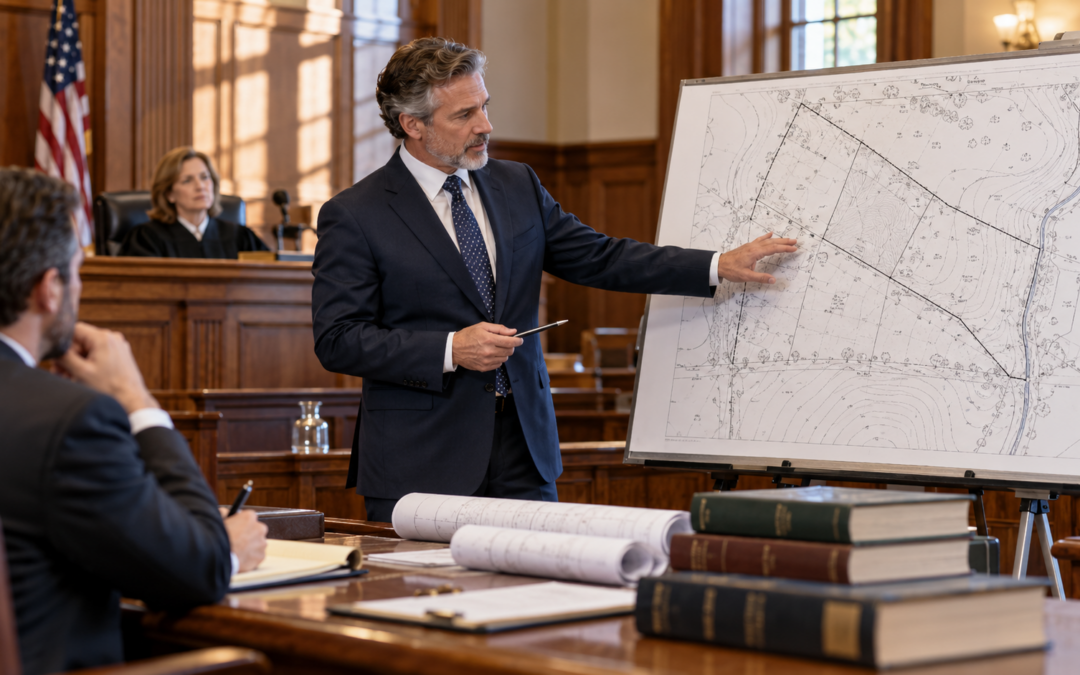
Visual exhibits matter as much as the report itself in surveying expert testimony. Expect scaled survey plats showing the disputed boundary line, monuments, structures, and dimensions; overlay maps comparing competing deed interpretations; and annotated exhibits that counsel and the expert can work through together during direct examination. These exhibits should be built with the attorney before trial. Handing them over the day before testimony begins is not a workable approach.
Supporting materials are not optional. Field notes, measurements, calculation sheets, historical deed abstracts, and photographs of physical monuments and site conditions all support the report and become part of the expert’s file that opposing counsel can request in discovery. A well-organized file signals credibility. A disorganized one is an invitation to impeachment.
Red flags in opposing survey evidence
Apply the same scrutiny to opposing survey evidence that you applied when vetting your own expert. The weaknesses that disqualify your expert are the same weaknesses that undermine theirs.
Common gaps in opposing expert files include licensure in a different state than where the dispute arises, credentials that do not match the specific dispute type, methodology that relies on a single deed without analysis of the broader chain of title, calculations that are not shown or not tied to a recognized standard, and field surveys that lack date stamps, equipment records, or monument documentation.
Watch for signs of advocacy over analysis. A surveyor who consistently testifies for one side, uses conclusory language without factual support, or shifts opinions between the report and deposition is not functioning as an independent expert. Opinions that acknowledge no uncertainty in genuinely ambiguous boundary situations are a sign the expert is advocating, not analyzing. Prior exclusions and judicial criticism are public record. A CV that does not match claimed credentials is verifiable with a few phone calls. Make those calls.
Preparing your expert for deposition and trial
The expert’s opinion is only as strong as the preparation behind it. Too many attorneys treat pre-deposition prep as a brief phone call the morning before. That approach produces exactly the kind of stumbling, hesitant surveying expert testimony opposing counsel is hoping for.
A three-phase approach is more reliable. Phase one starts immediately after retention: meet with the expert to define the opinion scope, the supporting materials, and the limits of testimony. Phase two runs before deposition: review the report line by line, identify every document the expert will rely on, and run mock cross-examination focused on methodology and data sources. Prepare a tabbed exhibit binder and confirm logistics including compensation, date, and video setup if the deposition is remote. Phase three runs before trial: rehearse the same opinions with the actual trial exhibits in hand, not a draft version.
By trial, the expert should have practiced with the plat maps and annotated exhibits, not just the written report. The sequence of exhibit introduction should be planned with counsel, and the expert should be able to point to a monument on an exhibit map and connect it to the underlying opinion in plain language that a jury follows without needing to reference notes or reorient themselves. That fluency comes from preparation, not from expertise alone.
The right expert changes the entire calculus
The strength of a property dispute case depends on the quality of the surveyor expert witness retained, and quality has a clear definition. Credentials must be verifiable and current. Methodology must be reproducible. Reports must be organized and honest about uncertainty. Exhibits must be built for a courtroom, not filed in a drawer.
For attorneys who need a land surveying expert witness with a documented track record across boundary, easement, title, and water-rights disputes, NLC / Tony Nettleman Land Surveying Expert Witness offers licensure across multiple states, co-authorship of recognized boundary law texts, a strong Daubert record, and the capacity to engage quickly after a conflict check. To discuss your case and request that conflict check, reach out directly to the NLC team.
The right expert does not just survive a Daubert motion, they make opposing counsel regret filing one.

0 Comments